
Lindsey Graham’s Last Sanctions
Campaign—and the Ukrainian Evidence
Washington Will Need
By Alex Chan
Partner | Lobbyist | International Business Development
Alex Chan is responsible for international development, strategic partnerships, international communications, and engagement with U.S. and global stakeholders. His expertise focuses on building trust, driving business growth, and supporting international initiatives.
The Senate vote was dramatic. The harder question is whether Ukraine can turn what it already knows about Russia’s war economy into focused American policy action.
Part One of Two
Estimated reading time: 7 minutes
Legislative status current as of August 25, 2026
Imagine a component recovered from a Russian missile after an attack on Ukraine.
A Ukrainian technical team knows what the component does. Researchers may have identified its manufacturer, distributor or route into Russia. Government officials understand why the case matters.
But evidence does not automatically become policy.
To matter in Washington, the information must answer several basic questions: What does it prove? Why should the United States care? Which American institution has authority to act? What action is Ukraine requesting?
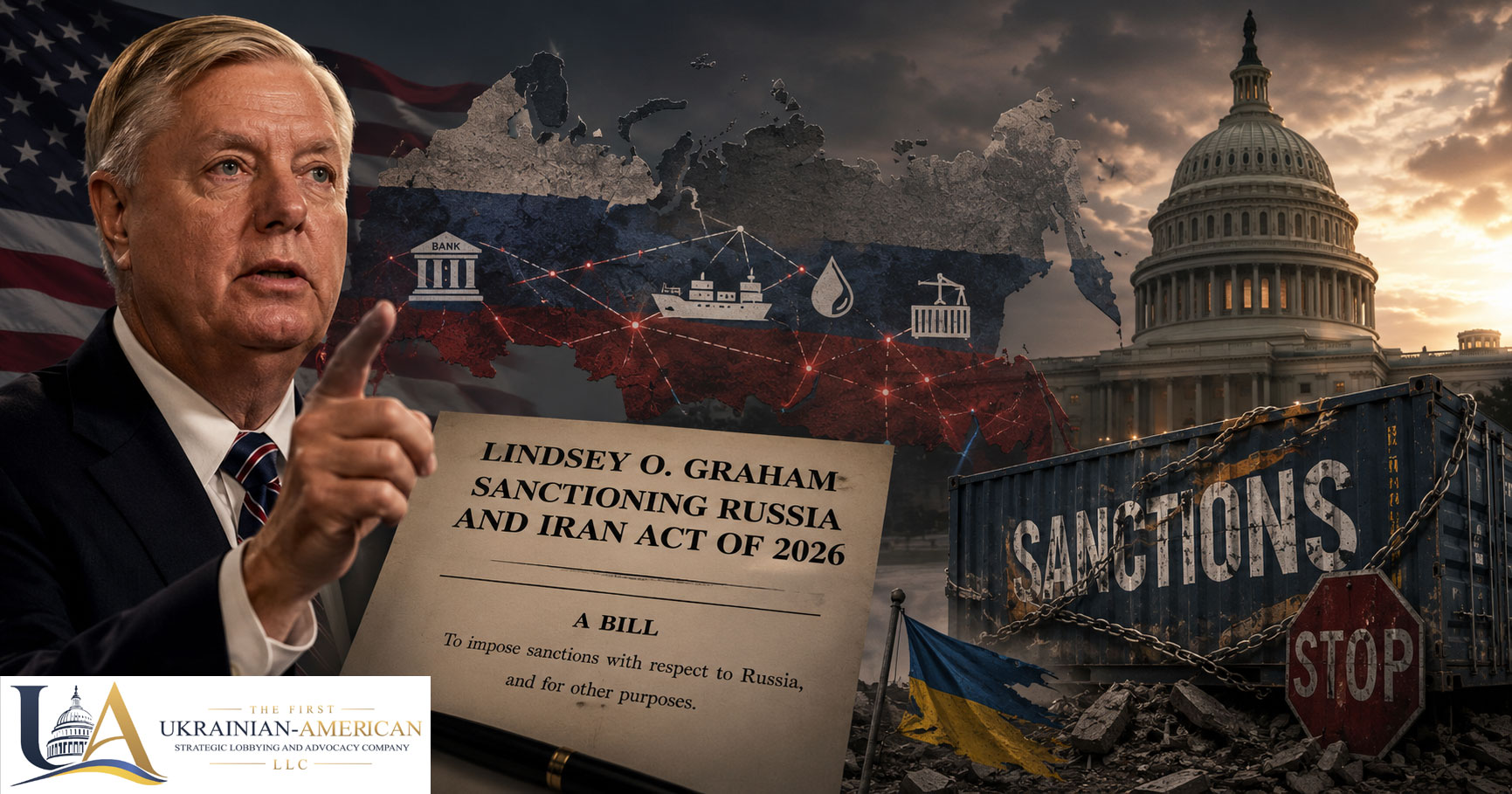
That gap—between Ukrainian knowledge and an American decision—is one of the opportunities created by the Lindsey O. Graham Sanctioning Russia and Iran Act of 2026.
The Senate passed the legislation on August 7 by an overwhelming 86–11 vote. A bipartisan House companion was introduced three days later, but the measure has not yet completed the House process or become law.
The Senate vote was a major political moment. For Ukraine, however, the more important work may begin after the headline.
Lindsey Graham’s Final Campaign
The bill carries unusual emotional significance because it became one of Lindsey Graham’s final political campaigns.
On July 10, Graham met President Volodymyr Zelenskyy in Kyiv. They discussed sanctions, air defense and continued American support for Ukraine. Before his death the following day, Graham had also reached an agreement with the White House on revised sanctions language that could gain administration support.
Graham and Democratic Senator Richard Blumenthal had spent more than a year building a bipartisan coalition around the proposal. After Graham’s death, more than 60 senators formally backed the revised legislation, which was later named in his honor.
Graham’s political argument was simple: sanctioning Russia itself was no longer enough.
Russia could continue financing the war through energy sales while using foreign banks, trading networks, industrial suppliers and other intermediaries to reduce the effect of Western restrictions.
Graham wanted the United States to place pressure on those external enablers as well as on Moscow.
That idea explains why the legislation could increase the value of credible information coming from Ukraine.
Ukraine has years of battlefield evidence, technical research and practical experience with Russian procurement, missile and drone production, attacks on infrastructure and sanctions evasion. The question is whether that knowledge can be organized and presented in a form American institutions can use.
A Bill Aimed at the Wider War Economy
The legislation reaches far beyond prominent Russian officials and oligarchs.
It covers Russian state-linked actors, major financial institutions, foreign support for Russia’s defense-industrial base, energy projects and networks helping Russia circumvent existing restrictions. It also contains provisions addressing vessels and service providers involved in transporting Russian commodities.
Several parts of the legislation would require the administration to begin reviews within 30 days of enactment and repeat them every 180 days. That matters because corporate structures, shipping arrangements, procurement routes and foreign intermediaries can change quickly.
The bill also contains its most politically controversial provisions.
It would authorize tariffs of up to 500 percent on goods imported directly from Russia and up to 100 percent on goods from qualifying countries that remain major purchasers of Russian energy or leading facilitators of Russian oil-sanctions evasion.
Those are maximum rates rather than automatic uniform tariffs, but they would still give the executive branch substantial economic leverage.
For Ukrainian readers, the attraction is obvious. Russia’s energy revenue helps finance its war, and third-country relationships have allowed Moscow to adapt to earlier sanctions.
The political risk is also real.
A tariff imposed across all goods from a major trading country is much broader than freezing the assets of one Russian official or company. It could affect American importers, supply chains and relations with countries that Washington may also need as partners.
The Senate Vote Concealed a Real Disagreement
The final 86–11 vote suggests overwhelming unity, but senators were not equally comfortable with every part of the bill.
Before final passage, the Senate voted on an amendment that would have removed the third-country tariff authority. That amendment failed by 32–64.
The difference between those two votes is revealing. Many senators supported stronger sanctions on Russia while remaining concerned about the breadth of the tariff power being transferred to the president.
The House will face the same tension.
Some members will emphasize the need to deprive Russia of energy revenue and punish the foreign networks sustaining its war.
Others will ask whether the tariff authority is too broad, whether presidential waivers could weaken enforcement, and whether the legislation provides enough oversight.
This is not simply a division between supporters and opponents of Ukraine. It is a debate over how pressure should be designed and controlled.
Ukraine therefore has an interest in defending the strongest parts of the legislation without dismissing legitimate concerns about implementation.
The recurring reviews should remain. The focus on Russia’s military, industrial and energy networks should remain. The requirement that Russia-directed measures can be terminated only following a peace agreement accepted by the free and independent Government of Ukraine should also remain.
At the same time, tariff decisions and presidential waivers should be transparent enough for Congress and allied governments to understand how the authority is being used.
Strong sanctions and disciplined oversight are not competing positions. Ukraine needs both.
Where Ukrainian Evidence Fits
The Graham bill could create repeated moments when American officials review Russian actors, foreign facilitators and changing evasion networks.
Those moments may give Ukrainian institutions a stronger reason to bring relevant information to Washington.
A Ukrainian ministry might possess evidence concerning attacks on critical infrastructure or foreign support for Russian military production.
A research institute or university center might have documented a procurement network or analyzed components recovered from Russian weapons.
A defense or technology company might have technical knowledge relevant to a broader policy issue.
An industry association could combine information from several organizations into a more substantial institutional case.
The best submission would not begin with a general demand for “more sanctions.”
It would begin with a specific problem:
Here is the conduct we have documented. Here is why it matters to Russia’s war capacity. Here is the American institution that should examine it. Here is the action we believe deserves consideration.
Not every case will lead to sanctions. Some information may be incomplete, outdated or legally insufficient. Some cases may be more appropriate for congressional oversight, export-control enforcement, private industry engagement or further investigation.
That is why credible preparation matters.
A Limited but Useful Role for FUAL
FUA Strategy & Lobby should not present itself as a sanctions law firm, forensic accounting practice or specialist maritime consultancy.
Its appropriate role is political: helping a Ukrainian institution define its objective, organize the public-policy case, identify relevant American audiences and sustain the engagement after the first meeting.
Where a matter requires legal, financial, technical or sector-specific expertise, FUAL can work with qualified outside specialists. Their analysis would support the campaign; FUAL would not attempt to replace it.
That distinction is important for a young firm. Credibility comes from knowing which work can be performed internally and when the client requires a wider professional team.
The potential client may also be a Ukrainian government institution rather than a private company.
U.S. law permits properly disclosed representation of foreign governments and foreign entities. FARA requires certain agents to register with the Department of Justice and disclose their relationship, activities, receipts and expenditures. It is a transparency regime, not a general prohibition on lawful representation.
A properly structured engagement could therefore allow a Ukrainian ministry, agency or public institution to obtain additional congressional outreach, policy research and stakeholder coordination without replacing the Ukrainian Embassy or official diplomatic channels.
From Evidence to Pressure
The Senate’s passage of the Graham bill was a powerful tribute to a senator who had become one of Ukraine’s most visible Republican supporters.
But the real test will come later.
Will the House complete the legislation?
Will the executive branch use the new authorities against the systems sustaining Russia’s war?
Will the reviews keep pace as those systems adapt?
And will credible Ukrainian information reach the officials making those decisions?
The next American action against Russia may begin with something small: a recovered component, a corporate record, a technical report or a documented relationship that appears insignificant when viewed alone.
The value emerges when the pieces are connected and the policy request becomes clear.
That is how Ukrainian evidence can become American pressure.
This article provides general policy analysis and does not constitute sanctions or legal advice.