A Year of Ukrainian Lobbying: How Legalized Influence Becomes an Economic Tool
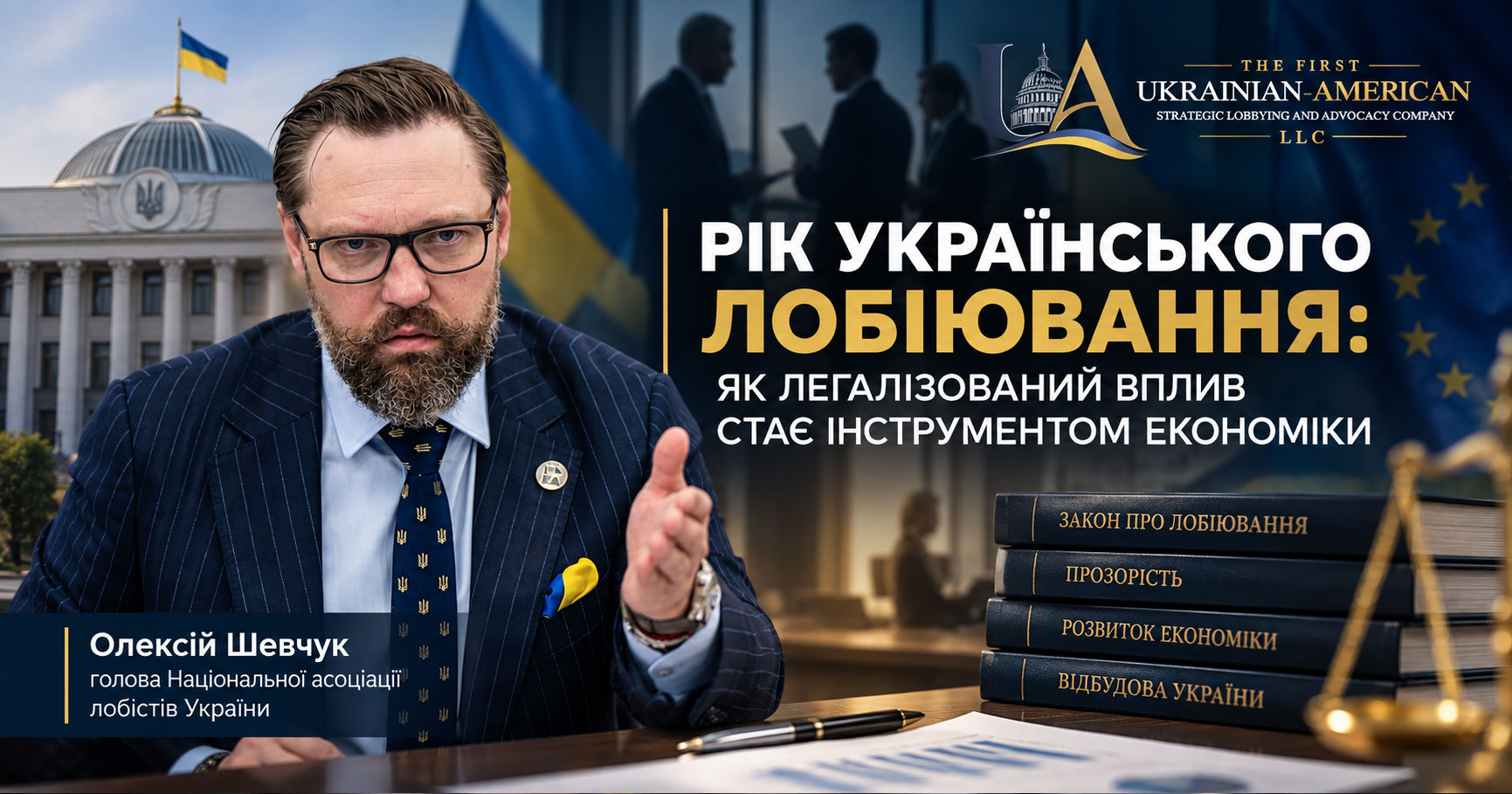
Oleksiy Shevchuk, Chairman of the Board of the Ukrainian Lobbyists Association
The first year of the lobbying law’s practical implementation is not merely a formal stage in the implementation of new rules. It marks the moment when the Ukrainian government, for the first time, made a systematic effort to bring one of the key functions of any economy—influencing government decisions—out of the shadows.
And if we take a broader view, this isn’t about regulating a specific type of activity. It’s about changing the model of interaction between business, the government, and society.
From Behind-the-Scenes Influence to Public Engagement
Influence on government decisions in Ukraine has always existed. But for a long time, it remained outside the formal framework: without clear rules, without transparency, and without accountability.
This created two parallel realities:
- the official sector—involving procedures, consultations, and public policy;
- informal—with backroom deals and hidden agendas.
The lobbying law is the first attempt to reconcile these realities.
His logic is simple: it’s impossible to ban influence—but we can make it visible, structured, and accountable.
In this sense, lobbying isn’t about “permission to influence.” It’s about institutionalizing that influence.
A New Career Instead of “Connections”
One of the key changes we are already seeing is the transformation of the very nature of the profession.
Traditionally, in the Ukrainian context, a lobbyist has been viewed as someone with access. A PR specialist is seen as an intermediary between business and the government.
Today, this approach is gradually becoming less relevant.
A new professional model is taking shape, in which a lobbyist is:
- regulatory policy analyst;
- specialist in influencing the rule-making process;
- compliance and anti-corruption risk expert;
- a strategic liaison between the business community and the government.
This signifies a fundamental shift: from personalized influence to institutional influence.
The First Year: Changing the Rules of the Game, Not the Numbers
It is a mistake to evaluate the first year based on quantitative metrics.
Registers, reports, and the number of interactions are merely external indicators. They do not reflect what matters most: a change in the behavior of market participants.
The real outcome of the first year lies elsewhere:
- influence is beginning to take shape as a process rather than an agreement;
- interests—as positions that are subject to public justification;
- interaction—as an action that leaves a mark;
- Reputation—an asset that depends on transparency.
It is a slow but irreversible process.
Education and Standards: Where the Market Is Actually Shaped
No law creates a profession on its own.
It merely sets the framework. Filling that framework is the task of the professional community.
Modern lobbying is a multidisciplinary field that lies at the intersection of:
- rights,
- economics,
- public administration,
- communications,
- anti-corruption compliance.
Without the establishment of standards, ethical guidelines, and a systematic educational framework, this field inevitably reverts to its informal nature.
That is precisely why the development of educational programs and professional institutions is not a secondary but a critical factor.
The Main Challenge: Drawing the Line
The most challenging issue for any lobbying market isn’t registration or reporting.
The hardest part is drawing a clear line between:
- transparent lobbying;
- expert participation in politics;
- public advocacy;
- and behind-the-scenes influence.
This boundary cannot be purely legal. It is always based, at least in part, on professional ethics.
And this is precisely where self-regulation plays a key role.
The Balance Between Control and Freedom
Another systemic risk is a bias toward excessive government control.
If regulation becomes too strict, the market will go underground again.
If, however, oversight is merely a formality, transparency will remain nothing more than a declaration.
An effective model is possible only if there is a balance:
- The government ensures compliance with regulations and transparency;
- The professional community establishes standards and ethical boundaries;
- society exercises external oversight;
- The court ensures that the rules are applied fairly.
This isn’t a compromise. It’s the structure of a mature market.
Lobbying as an Instrument of Economic Policy
In the context of Ukraine’s reconstruction, the importance of lobbying is increasing dramatically.
This is no longer about a single profession, but rather about the infrastructure of decision-making.
It is precisely through these mechanisms of representation that the following will be established:
- investment rules;
- infrastructure recovery policy;
- energy regulation;
- defense-industrial complex;
- war risk insurance;
- integration into European markets.
For international businesses, it is critically important to have a clear, transparent, and predictable channel for interacting with the government.
And lobbying in its modern form is precisely that.
What’s next?
The first year showed that lobbying has taken root in Ukraine.
But that’s just the beginning.
The next step is much more difficult:
- the integration of lobbying into actual rulemaking processes;
- digitization of interactions with Parliament and the government;
- a clear distinction between lobbying, government relations, and advocacy;
- building trust in the profession;
- protecting the market from defamation and counterfeiting.
In fact, a key question is currently being decided: Will lobbying in Ukraine become a tool for economic development—or will it remain merely a legalized form of old practices?
The fate of the profession depends on the answer to this question.
It will also determine the quality of government decisions over the next decade.