
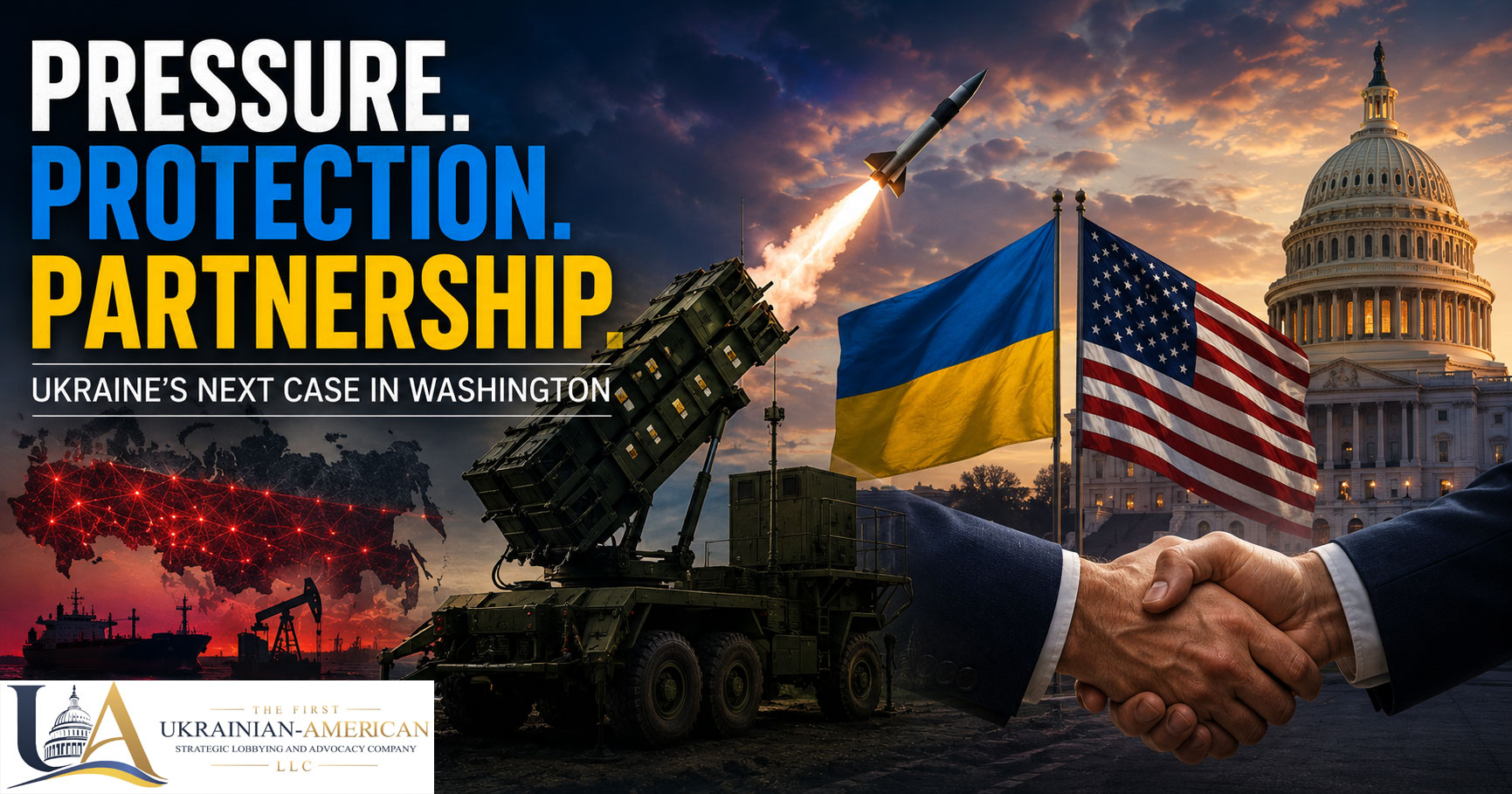
Pressure, Protection, Partnership: Ukraine’s Next Case in Washington
By Alex Chan
Partner | Lobbyist | International Business Development
Alex Chan is responsible for international development, strategic partnerships, international communications, and engagement with U.S. and global stakeholders. His expertise focuses on building trust, driving business growth, and supporting international initiatives.
Sanctions and Patriot production are separate issues. Together, however, they reveal how Ukraine wants its relationship with the United States to evolve—from emergency assistance toward long-term strategic cooperation.
Part Two of Two
Estimated reading time: 7 minutes
Legislative status current as of August 25, 2026
One meeting in Kyiv placed two major Ukrainian priorities in the same conversation.
On August 23, President Volodymyr Zelenskyy met U.S. Senators Richard Blumenthal and James Lankford. He urged the United States to complete passage of the sanctions legislation developed by the late Senator Lindsey Graham.
Zelenskyy also discussed Russia’s intensifying ballistic attacks, Ukraine’s immediate need for additional interceptor missiles and ongoing work to obtain licenses to produce missiles for Patriot systems in Ukraine.
The sanctions bill cannot provide Patriot missiles or authorize their production. These are separate political, industrial and governmental processes.
But together they express a larger Ukrainian strategy:
Pressure Russia. Protect Ukraine. Build a lasting partnership.
This is also a useful framework for Ukrainian industries and public institutions considering how to present themselves in Washington.
The strongest Ukrainian case is no longer simply that the country needs assistance.
It is that Ukraine has knowledge, capabilities and strategic value that can strengthen the United States and its allies.
Pressure: Weaken the System Behind the Attacks
The Graham bill addresses the financial, energy and industrial systems that support Russia’s ability to wage war.
The Senate passed the measure by 86–11, and a bipartisan House companion has now been introduced. The legislation still requires House action before it can reach the president.
For Ukraine, the immediate objective is to preserve meaningful pressure on Russia and the foreign networks sustaining it.
But sanctions policy should not be treated as a subject belonging only to diplomats and lawyers.
It also affects the broader discussion about what should replace Russian energy, industrial inputs and strategic dependencies.
When Washington restricts a hostile supplier, policymakers eventually need to identify a safer alternative.
That creates a potential opening for Ukrainian energy, infrastructure, technology and industrial organizations. Their strongest argument is not simply that they are Ukrainian and deserve support.
It is that they can contribute to a problem the United States and Europe already need to solve.
Protection: The Immediate Reality of the War
Sanctions operate over time. Russian missiles are attacking Ukraine now.
That is why Zelenskyy placed air defense beside economic pressure in his conversation with Blumenthal and Lankford.
One policy seeks to reduce Russia’s future ability to produce and finance weapons. The other seeks to stop those weapons after they are launched.
Ukraine therefore cannot choose between sanctions and protection. It needs both.
The public discussion of Patriot production also signals that Ukraine wants to move beyond dependence on periodic deliveries. Kyiv increasingly seeks deeper and more durable forms of cooperation with American and European industry.
That ambition is strategically understandable. It is also technically, legally and commercially complex.
For a Ukraine–U.S. government-relations firm, the appropriate role is not to market a particular missile, drone or weapons system.
The more credible contribution is to help American policymakers understand the political case for stronger institutional cooperation with Ukraine’s defense and security community.
Ukraine has accumulated battlefield experience that few countries possess. Its military, engineers, companies and researchers have learned under the pressure of a large-scale modern war.
That experience can inform discussions about allied readiness, production capacity, innovation and future deterrence.
Those are legitimate political subjects even when a firm is not involved in a particular defense transaction.
Partnership: From Receiving Aid to Contributing Capacity
The next stage of U.S.–Ukraine relations should not be framed only around what Washington can provide to Kyiv.
It should also ask what Ukraine can contribute to a wider democratic security system.
In energy, Ukraine has experience operating and repairing infrastructure under sustained attack. Its gas-storage capacity, nuclear sector, grid expertise and resilience technologies may have relevance beyond Ukraine itself.
In manufacturing and technology, Ukrainian companies have adapted quickly to disruption, supply shortages and battlefield demands. Some of those lessons may support wider allied resilience.
In critical minerals and industrial materials, Ukraine may contribute to efforts to reduce dependence on Russia and other strategic competitors.
The exact commercial value of any project must be tested independently. Political relevance cannot substitute for sound ownership, financing, management or technical readiness.
But political relevance can determine whether an otherwise credible project receives serious attention in Washington.
A company that enters the United States saying only that it needs investment will face intense competition.
A company that can explain how it supports American energy security, European resilience or a safer strategic supply chain has a stronger public-policy case.
Lindsey Graham’s Political Lesson
Graham understood that support for Ukraine had to be connected to American power and American interests.
He did not present the sanctions bill only as an act of solidarity. He argued that it would give the United States leverage over the countries and institutions helping finance Russia’s war.
That argument helped unite national-security Republicans, Democrats and the Trump administration around a common legislative vehicle. Graham and Blumenthal spent more than a year building the coalition, while Graham secured White House agreement on revised language shortly before his death.
The lesson for Ukrainian organizations is broader than sanctions.
A proposal becomes more persuasive in Washington when it answers three questions:
What shared problem does it address?
What can Ukraine contribute?
Why does action serve an American interest?
This does not mean hiding Ukraine’s needs. It means placing them within a wider strategic argument.
An energy proposal can be linked to reducing Russian leverage.
An infrastructure proposal can be linked to resilience.
A technology proposal can be linked to allied security or supply-chain reliability.
A sector association can explain why stronger cooperation with Ukraine benefits an entire American policy objective rather than only one company.
The Value of a Sector-Level Campaign
Not every Ukrainian company needs its own Washington campaign.
In many cases, an association, research institution, investment platform or public body may be better positioned to present a broader sector story.
Instead of asking the U.S. government to support one company, the organization can explain a common policy barrier, a strategic Ukrainian capability or a larger opportunity for bilateral cooperation.
That approach has several advantages.
It is less transactional. It carries greater institutional credibility. It allows policymakers to understand the wider issue before considering individual projects.
It also reduces the risk of making promises that no advocacy firm can control.
A congressional office may help elevate an issue, request information or support a policy direction. It generally cannot guarantee a commercial agreement, private investment or procurement decision.
The first result of a serious campaign may therefore be greater political recognition, clearer understanding of the barriers or a more durable channel between Ukrainian and American institutions.
Those outcomes are less dramatic than announcing a contract. They are often necessary before one becomes possible.
Where FUAL Fits—and Where It Does Not
FUA Strategy & Lobby’s present expertise is in politics, congressional engagement, strategic communications and U.S.–Ukraine government relations.
It is not an arms broker and does not sell particular weapons systems. It does not handle controlled technical information, export licensing or transaction-level defense trade work.
Where those matters arise, qualified legal and technical specialists must lead them.
FUAL’s narrower role is to help a Ukrainian institution clarify its political objective, connect that objective to an American interest and present the case to appropriate public-policy audiences.
That may include work for a private company, an industry association, a research organization or, under a properly structured and disclosed arrangement, a Ukrainian public institution.
The purpose is not to promise a result controlled by Congress, the executive branch or private industry.
It is to ensure that Ukraine enters the discussion with a serious argument rather than a general request for support.
A Simple Public Story
Behind every Washington campaign are complicated questions about law, politics, financing, timing and institutional authority.
The public story should still be simple:
There is a shared strategic problem. Ukraine can contribute to the solution. The United States has a reason to participate.
The August meeting between Zelenskyy, Blumenthal and Lankford illustrated that formula.
Russia’s war economy must face stronger pressure.
Ukraine’s cities and infrastructure must be protected.
The capabilities required for long-term security must be built through deeper cooperation.
Lindsey Graham helped create a political bridge between Ukraine, a Republican White House and a bipartisan Senate.
The next task is to turn that personal bridge into a durable institutional partnership.
That is the larger opportunity behind the sanctions bill—and the more important story for Ukrainian organizations looking toward Washington.
This article provides general policy analysis and does not constitute legal, export-control, investment or procurement advice.